Every software vendor is adding AI to their product and announcing it as transformational. That’s creating a lot of noise that makes it hard to tell which AI features will make an actual difference and add value, and those that are AI just for AI’s sake.
Compliance and policy management software is no different. Compliance teams are right to ask if AI is truly embedded into a product, is more of gimmick, or even if it is truly AI at all.
In policy management specifically, AI is being applied in a small number of genuinely useful ways, but in a larger number of ways that amount to not very much.
Using AI for compliance: which policy management problems are AI solving?
Tech vendors are using AI to try to tackle some of the thorniest compliance and policy management problems. One of these is getting employees to actually digest and understand policies.
Getting employees to acknowledge that they have read a policy is, with automation, a largely solved problem, as long as you make it easy and effortless for employees to access the information they need. But getting them to actually understand a policy and being able to prove that to a regulator? That’s significantly harder to do and tick-box compliance is endemic.
A second key issue is the information retrieval problem. Most organisations have large, complex policy libraries. Employees with questions and who need to know what a policy says about a specific situation have to search through documents, often without finding a clear answer. They either give up or email somebody. However, AI is now being used to assess this directly.
AI knowledge checks: testing understanding, not just awareness
One of the most impactful uses of AI in policy management is the automated generation of comprehension questions from policy content. After an employee reads a policy, AI generates a set of comprehension questions based on the actual content of that policy, which policy owners can then adjust and tweak as they see fit. The employee must answer correctly to complete their attestation, demonstrating their understanding.
This matters enormously in regulated sectors. Financial services firms operating under the Senior Managers and Certification Regime need evidence that regulated individuals understand the policies governing their conduct - not just that they clicked a button.
One critical caveat for regulated organisations is where the AI runs. Knowledge checks that send policy content to a third-party AI model create a potential data residence issue. The most architecturally sound approach for regulated sectors is AI that runs inside the organisation’s own Microsoft tenant, using Azure OpenAI, with no data leaving the environment, ensuring existing policies around data residency and data sovereignty are adhered to.
AI knowledge assistants: answering questions before they are asked
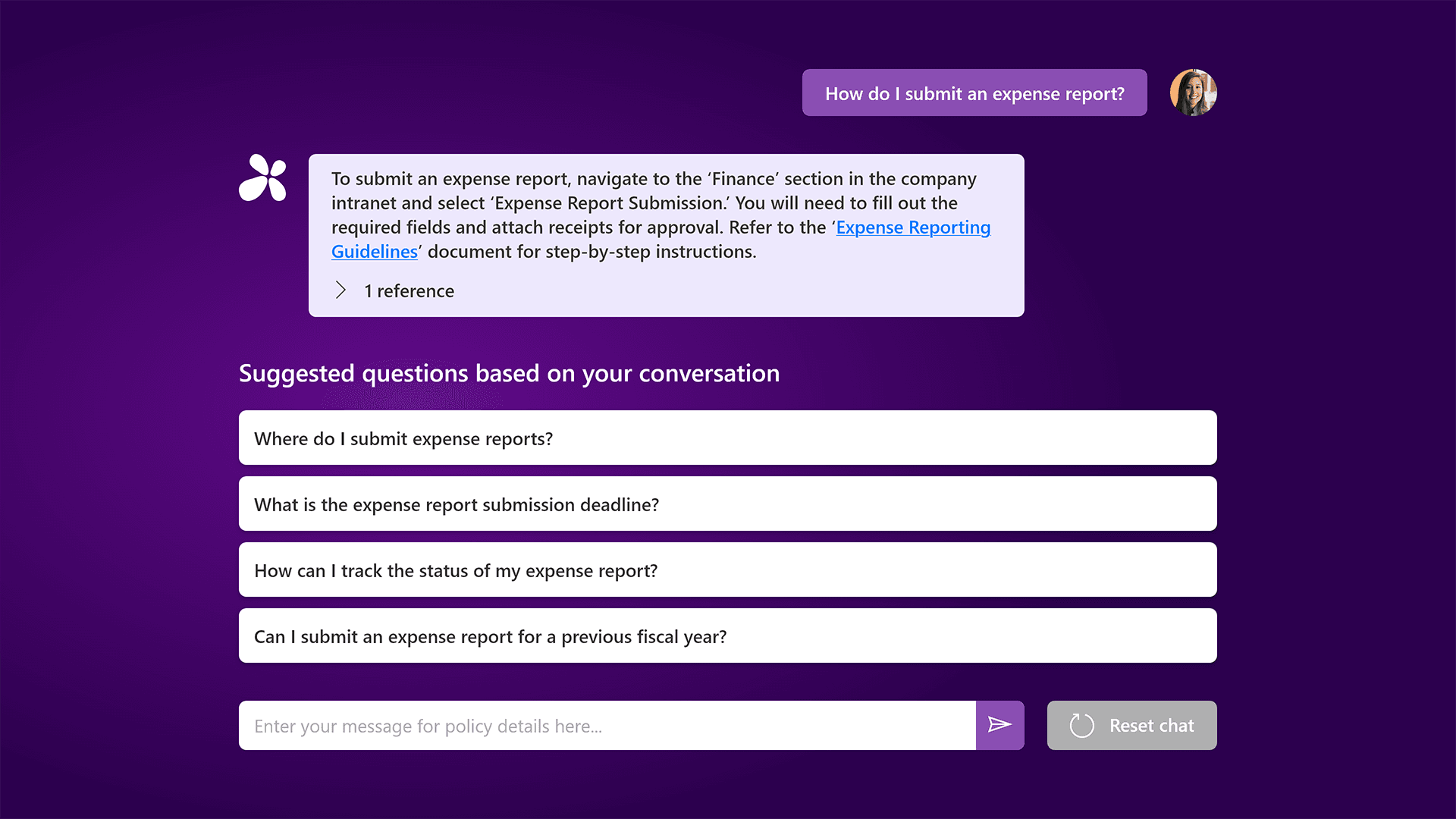
Chat interfaces are revolutionising how employees search for information and receive data.
The policy knowledge assistant is a conversational interface that allows employees to ask questions in plain English about policies and procedures and receive accurate, cited answers in real time. Instead of an employee searching through a 40-page data protection policy, they ask the question and receive the answer - with a reference to the specific policy and section.
The key quality criterion and risk is accuracy with citations. A knowledge assistant that gives plausible sounding, but incorrect answers is worse than no assistant at all. More often than not, incorrect answers are down to duplicated and conflicting policies, out-of-date versions, or missing policies. Implementing a chatbot without robust policy lifecycle management in place leads to real problems.
Which AI policy management software features do not work well yet?
AI solutions are still evolving, and not all AI policy management features make that much of a difference:
The data sovereignty and residency question every regulated organisation must ask
One question that should precede any evaluation of AI features in compliance software is: where does my data go when the AI processes it?
The safest and technically correct architecture for regulated sectors is AI that runs entirely inside the organisation’s own Microsoft Azure environment, using Azure OpenAI, with full data residency controls and no third-party training on the organisation’s content.
When evaluating any AI feature, ask:
Frequently asked questions
Will AI replace compliance managers?
What is Azure OpenAI and why does it matter for compliance?
How do AI knowledge checks differ from traditional quizzes?
About the author

Dan Hawtrey
CEO and product lead
Dan Hawtrey is CEO of Content Formula and the driving force behind Xoralia, a policy management platform built natively on Microsoft 365. Dan writes regularly on policy management, compliance, and the evolving role of AI in how organisations manage knowledge. His articles are grounded in real conversations with the companies and teams using Xoralia day to day.